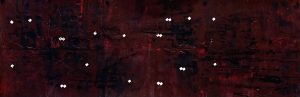
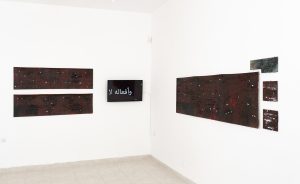
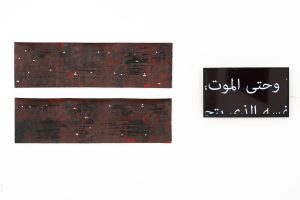
Samer Salama’s debut solo show comprises a series of new works made in a process of painterly and graphic imprinting, inspired by The Book of Disquiet (“Livro do Desassossego”) by the Portuguese author Fernando Pessoa. In his practice, Salama embraces chance and fluidity in both material and form: first, he paints layers of oil and acrylic paint on various surfaces – canvas, ceramics, metal, paper, and ready-made objects – and then he imprints one surface onto another through the direct contact of the wet surfaces. In this process, leftover paint and fragments are transferred from one surface to the other, forming the final layer of each.
Mirroring the fragmentary nature of the book, which is comprised of incomplete reflections, musings, and descriptions that map the urban psyche, each work bears a quote from the book, in different degrees of erasure. The fragments that Salama chose to quote are those that left their mark on him, ones that touch on human behavior in situations of tension and instability and serve as a safe place for the parallel existence of complex and even contradictory emotions. The act of erasure leaves a persistent residue of meaning on the surface in the form of Hebrew orthography bright marks (niqqud). Traces. These conjure the gap between the legible and visible and the missing and hidden into the exhibition space, rendering it an intermediate space that invites a continuous and lingering gaze, rather than a deciphering perspective.
Facing the window that overlooks the landscape within the exhibition space stands a street bench, upon which Pessoa’s book is laid out in various languages. Only in its complete form and original dimensions, designed to be held in a reading position, does it offer the possibility of deciphering. Visitors are invited to sit and leaf through its pages, search for the missing text, gaze at the expansive verdant landscape outside, and contemplate. Perhaps the gap between there and here, between then and now, between languages, cultures, and identities will meltaway, if only for a moment.
Irit Carmon Popper, Curator